
Divevolk or underwater camera: the comparison nobody sponsors

This question comes up more and more. It used to always be "which camera should I buy?". Now, increasingly, the question is different: "Is it worth buying a Divevolk to use my phone underwater, or should I just go straight to a dedicated camera?"
It's a legitimate question. And the honest answer is: it depends. But not in a vague way — it depends on very specific things I'm going to explain here.
The first thing you need to know about this comparison: neither of these brands sponsors us or has any commercial agreement with BTO.
What you're about to read is the opinion of someone who has used both systems underwater and who has spent years advising divers on what equipment to buy based on their real objectives. No financial incentive involved.
In the world of diving gear, that's less common than it should be.
Let's get into it.
First, let's clarify what each system actually is
What Divevolk is (and its alternatives)
Divevolk is a brand that manufactures waterproof housings and accessories for smartphones. The idea is simple: you put your phone (iPhone, Samsung, Pixel…) inside a sealed case rated to a certain depth, and use the phone's camera to photograph and film underwater.
Divevolk isn't the only brand in this segment. You'll also find SeaFrogs, AOI, Kraken Sports, Meikon and others with similar products. When I say "Divevolk" in this post, I'm referring to this entire ecosystem of smartphone underwater housings.
Top-end Divevolk models support depths of up to 60 metres, are compatible with accessory wet lenses (macro, wide-angle, fisheye) and external lighting systems. We're not talking about the 20€ waterproof pouch you use on the beach — these systems cost between 250 and 800 € depending on the model and accessories.
What a dedicated underwater camera is
A dedicated underwater camera is a system specifically designed for underwater photography. It can be:
Submersible compact (Olympus TG-7, Ricoh WG-80…): waterproof by design, no additional housing needed to a certain depth
Advanced compact with housing (Sony RX100, Canon G7X + Nauticam or Ikelite housing)
Mirrorless with professional housing (Sony A7, OM System OM-1 + Nauticam housing or similar)
The common denominator is a dedicated sensor, dedicated optics and a design built to work in a hostile environment with real photographic objectives.
The comparison: 8 key criteria
Let's compare both systems across the 8 criteria that actually matter. No hedging.
1. Image quality
Divevolk / smartphone housing:Today's high-end smartphones (iPhone 17 Pro, Samsung S26 Ultra) have sensors that would have seemed impossible five years ago. Underwater with good lighting, the results can be genuinely surprising. The phone's computational processing — filling in detail, managing noise, optimising dynamic range automatically — does an enormous amount of work.
The problem is when conditions aren't perfect: low light, fast-moving subjects, rapid fauna, depth. That's when the phone's small sensor shows its limits. Digital noise appears, focus loses precision and dynamic range narrows significantly.
Dedicated camera:A compact like the Olympus TG-7 already outperforms the phone in difficult conditions. An advanced compact or mirrorless with housing does so overwhelmingly. Larger sensor, purpose-built optics, genuine RAW processing.
Verdict: 🏆 Dedicated camera — in controlled conditions the phone holds up, in difficult conditions the difference is clear.
2. Video quality
Divevolk / smartphone housing:Here the phone is more competitive. Current iPhones and Samsung flagships record at 4K minimum with exceptional stabilisation, and video quality in good light is genuinely very good. For social media video, Instagram reels or YouTube content, the phone is perfectly capable.
Dedicated camera:GoPro and action cameras remain the benchmark for quality underwater video, and a mirrorless with good optics delivers results the phone can't match for log footage and post-production. But in the mid-range compact segment, the difference with a phone is smaller than it looks.
Verdict: 🤝 Relative draw — for social media, the phone is perfectly valid. For serious production or advanced post-production, the dedicated camera wins.
3. Ease of use
Divevolk / smartphone housing:Here the phone has a real advantage. The interface you already know, the gestures you've already internalised, the apps you already use — all of it works inside the housing. Power on, aim, shoot. No new menus to learn, no button combinations to remember with gloves on.
Most high-end Divevolk systems also include a Bluetooth remote that lets you shoot without touching the screen — a genuinely useful practical advantage underwater.
Dedicated camera:Submersible compacts are reasonably intuitive, but the learning curve exists. An advanced compact or mirrorless with housing requires prior configuration, familiarisation with controls underwater and several adaptation dives before using it with fluency.
Verdict: 🏆 Divevolk — familiarity with your own device is a real advantage, especially at the beginning.
4. Versatility and upgrade options
Divevolk / smartphone housing:High-end systems allow adding accessory wet lenses (macro, wide-angle), arms and external lights. Versatility has improved significantly in recent years. But you remain prisoner of your phone's sensor — when a better phone comes out, you may need a new housing adaptation.
Dedicated camera:An advanced compact or mirrorless system with housing grows with you more organically. Add a strobe, swap the port for a different lens, expand the system without changing the camera. The investment amortises better over time.
Verdict: 🏆 Dedicated camera — more scalable, higher ceiling for growth.
5. Size and travel
Divevolk / smartphone housing:You already carry the phone. The Divevolk housing adds volume but remains considerably more compact than any dedicated camera system with housing. For a diver already travelling with lots of equipment, this isn't a minor detail.
Dedicated camera:A submersible compact is small. An advanced compact with housing takes up more. A mirrorless with housing, ports, arms and strobes may need dedicated luggage and easily exceeds baggage limits.
Verdict: 🏆 Divevolk — for light travellers, the size difference is real and relevant.
6. Real price (not the advertised one)
Here it pays to be honest about what each system actually costs — not the housing price alone, but the price of having a functional system underwater.
Divevolk / smartphone housing:
Component | Approximate cost |
Divevolk housing mid-to-high range | 250-600 € |
Wide-angle wet lens | 80-200 € |
Macro wet lens | 60-150 € |
Bluetooth remote | 50-80 € |
1 basic video light (typically 2 are used) | 150-300 € |
Total functional system | ~600-1,300 € |
(The phone isn't counted as you already have it — but if you needed to buy a flagship phone specifically for this, add over 1,000 € to that figure)
Dedicated camera:
System | Approximate cost |
Olympus TG-7 + official housing + light | 900-1,200 € |
Advanced compact + housing + basic light | 1,800-3,000 € |
Mirrorless + housing + ports + strobes | 5,000-10,000 €+ |
Verdict: 🤝 Depends on the level — at entry and mid-range, the prices are more similar than they appear. At the high end, the dedicated camera is inevitably more expensive.
7. Durability and confidence
Divevolk / smartphone housing:Waterproofing depends on the housing's o-rings and how well you maintain them. A well-maintained high-end Divevolk is reliable. But if the housing floods, you lose both the case and your phone — and in that phone are your contacts, personal photos, work applications and sensitive data.
Dedicated camera:Submersible compacts like the TG-7 are specifically designed for hostile environments and are extremely robust. If a dedicated camera floods, you lose the camera — not your digital life.
Verdict: 🏆 Dedicated camera — the risk of losing your phone adds a layer of stress that many divers underestimate.
8. Photographic learning curve
Divevolk / smartphone housing:The phone hides photographic technique behind automatic processing. You take good photos faster, but you learn less about what's actually happening. For someone who just wants good memories, perfect. For someone who genuinely wants to learn underwater photography, the phone's automatic mode can become a ceiling.
Dedicated camera:A camera with manual controls forces you to understand exposure, ISO, shutter speed, aperture, white balance. It's harder at the start and more frustrating in the first dives. But when those concepts "click", you develop a technical level that can't be acquired with a phone on automatic.
Verdict: 🏆 Dedicated camera — if your goal is to genuinely learn underwater photography, the learning curve is an advantage, not a drawback.
When each system is better
Use Divevolk / smartphone housing when…
🤿 You dive occasionally (fewer than 50 dives per year) and diving isn't your primary activity
📱 You already have a recent high-end phone and don't want to duplicate investment in another device
🎬 Your main objective is video for social media, not quality photography
✈️ You travel light and equipment size is a critical factor
🌊 You mostly snorkel or do shallow recreational dives in predictable conditions
👥 You want to share content in real time — the phone lets you upload directly without file transfers
Use a dedicated camera when…
📸 Underwater photography is a genuine motivation for diving, not an extra
🔬 You're interested in macro — no phone matches a TG-7 in this area
🌊 You dive in variable conditions: low light, fast fauna, depth, currents
📈 You want a system that grows with you as you progress
🐋 Your objectives include photographing large fauna (mantas, sharks, cetaceans) with real quality
🎨 You want to learn RAW underwater editing and get the maximum from every image
🏆 You aspire to enter underwater photography competitions with genuine chances
Which diver profile each serves
🔵 Occasional diver / traveller who also dives→ Divevolk is your option.You dive 5-10 times a year, at tourist destinations in good conditions, and you want photos and video that do justice to what you see. No need to invest in a complete photographic system. Divevolk gives you very solid results with a reasonable investment and without complicating your luggage.
🟡 Active diver with interest in photography→ Start with Divevolk, but plan the transition.If you dive regularly and photography is starting to genuinely matter to you, Divevolk can be a good entry point to understand what type of photography you enjoy (macro? wide-angle? video?) before investing in a dedicated system. Use it as an exploration phase, not a final destination.
🟠 Developing underwater photographer→ Dedicated camera, no question. Start with the TG-7.If you've been diving a while, you know photography matters to you, and you're willing to learn — go straight to a submersible compact with manual controls. The TG-7 with its official housing and a small light is the most solid entry point on the market for serious underwater photography. And it has a learning ceiling that no phone can match.
🔴 Advanced or professional underwater photographer→ Mirrorless with housing. No argument.If your goal is editorial, competition or publication-level images, the phone is not an option. The leap in sensor, optics and technical control that a mirrorless with professional housing provides has no equivalent in any current smartphone system — and none is on the horizon.
My honest verdict
After using both systems and advising many divers on this decision, my position is clear:
Divevolk is a legitimate tool for a specific profile. It's not a beach toy or a second-rate solution — it's a functional system that makes real sense for the diver who wants quality images without the complexity of a dedicated photographic system.
But if underwater photography genuinely calls to you, Divevolk will fall short. Not because of the hardware itself, but because a phone on automatic doesn't teach you to see light, doesn't teach you to manage exposure, doesn't teach you to anticipate fauna movement. And those skills are what separate the photos that get forgotten from the ones that define you as a photographer.
I'll also add: if your goal is to make underwater videos focused on social media, I'd probably lean toward Divevolk — as long as your phone is high-end and records in good quality. Today's flagship smartphone sensors genuinely compete with advanced-range cameras.
One more small advantage that I consider key to the phone option is the overheating issue. Dedicated underwater cameras typically have a time/memory limit before the system overheats and starts throwing errors. This can happen with smartphones too, but you generally have more time and capacity before it occurs.
My final conclusion:It depends on the use you want to give it and how much you're willing to spend and learn in underwater photography and video.
For the vast majority, Divevolk is more than enough — especially with the range of accessories now available. It's the most viable and optimal alternative on the market for the average user.
But if you want to go deep into underwater photography, I'd recommend investing in a dedicated compact camera system. If you need more information on that front, we have another blog post that covers it in detail. (Internal link to underwater camera post)
Want to learn how to get the most from your equipment?
Having the right equipment is the first step. Knowing how to use it is what makes the difference.
Every Born to the Ocean expedition includes an underwater photography workshop where we work with whatever equipment each participant brings — Divevolk, compact, mirrorless or GoPro. There's no mandatory system: there's technique, composition, light and real-time feedback in the water.
Every participant also receives a personal underwater photography session during the trip — your own images captured by a professional photographer below the surface, so you leave with real photographs of the experience.
📸 And if you want to go further into editing — recovering the colour the water takes away, working with underwater RAW, developing your own style — the BTO Academy is developing a dedicated Lightroom CC editing course for underwater photography. Coming soon.
If you have questions about which equipment suits you before a trip, or want to know more about the workshops, let's talk on WhatsApp. No commitment.
From Born to the Ocean, we hope this has helped you make a clearer decision about which system suits you best.
Thank you for reading all the way to the end — see you in the blue! 🤿
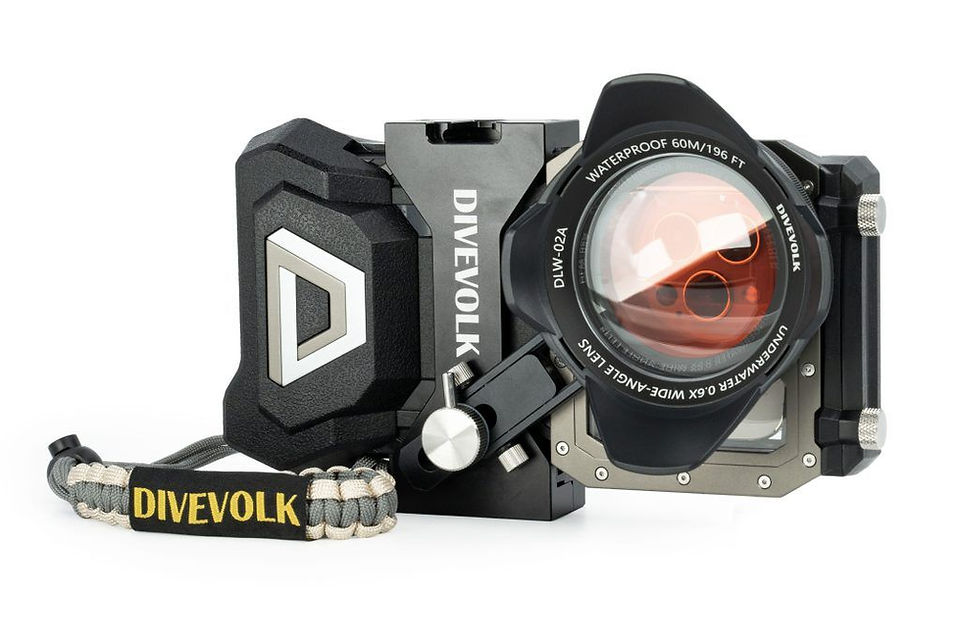
Kit carcasa Divevolk 
Kit completo Divevolk con lentes macro y angular, filtros, luces de video, soporte y brazos 
Diferentes tipo de cámaras submarinas: Divevolk, Olympus y Sony alpha 
Kit completo cámara compacta submarina marca Sony Alpha 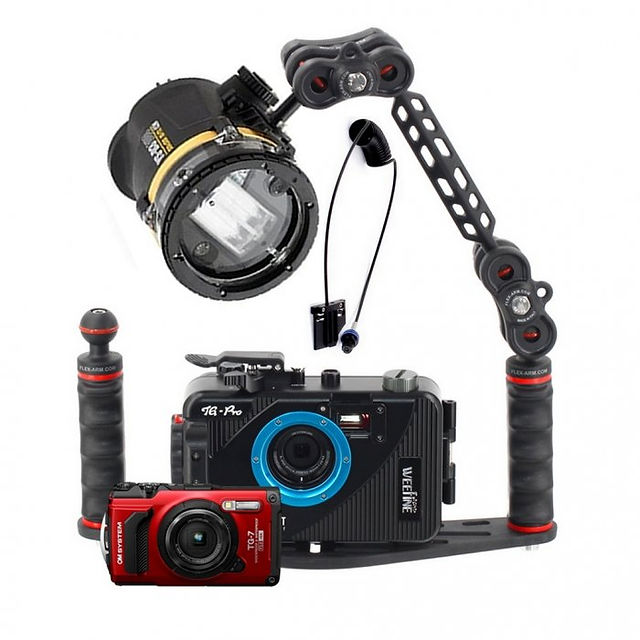
Kit completo cámara submarina compacta Olympus TG7 
Kit básico divevolk con filtro rojo y accesorio gran angular


Comments