
Orcas hunting in the Norwegian fjords: the greatest hunting spectacle on the planet
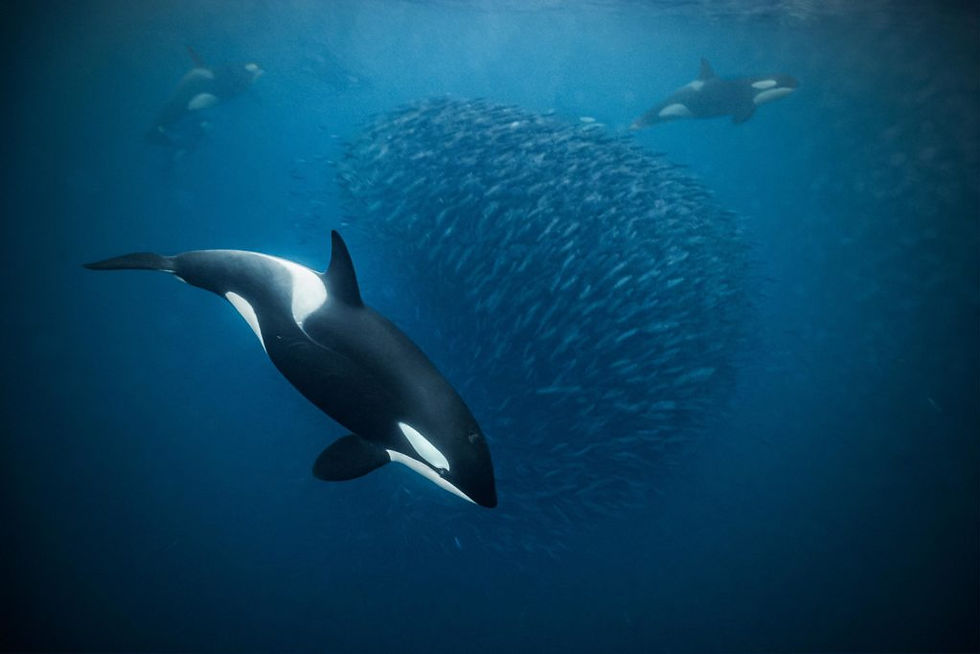
There are images that cannot be manufactured. That cannot be staged. That simply happen — if you are in the exact place, at the exact moment, with enough patience and enough cold.
An orca surfacing from the dark water of an Arctic fjord, with a snow-covered mountain behind it and the sky igniting with the northern lights. A herring school compressing into a living ball while dozens of orcas surround it with surgical precision. The tail slap of a humpback whale bursting into the hunt from below. And you, in a drysuit, floating in 3°C water, making no sound, while the animals take no notice.
That is what happens every winter in the fjords of northern Norway. And it is, without any possible exaggeration, the most extraordinary hunting spectacle on the planet.
Why the Norwegian fjords are the world's orca epicentre
The story begins with herring.
Every winter, between October and January, enormous schools of Atlantic herring (Clupea harengus) migrate northward toward the cold, plankton-rich waters of the Arctic fjords. These schools can contain millions of individuals moving as a single entity — a dense, silver mass travelling through narrow fjords between walls of rock and ice.
And where the herring goes, the orcas know.
The North Atlantic orcas (Orcinus orca) have followed this school for generations. Not through pure instinct — through cultural knowledge transmitted within family clans. Mothers teach their calves where the herring is, when it arrives, how to hunt it. The migratory routes of Norwegian orcas are largely learned routes, not genetically programmed ones. Which makes it all the more fascinating.
The concentration of orcas that forms around Skjervøy — a small island municipality in the province of Troms, 200 km north of the Arctic Circle — is one of the largest seasonal gatherings of this animal ever recorded. Up to 50-60 orcas have been observed simultaneously in the same fjord. Not in open ocean. In a narrow fjord, surrounded by snow-covered mountains, with the black, dense Arctic water as the only backdrop.
The hunting technique: what makes orcas unique
Orcas are the ocean's apex predator — above the great white shark, above any other cetacean. But what separates them from every other predator is not size or speed. It is collective intelligence.
In the Norwegian fjords you can observe one of the most sophisticated hunting techniques in the animal world. It is called carousel feeding — and it works like this:
A group of orcas detects the herring school. Some individuals dive and surround the school from the sides and below, compressing it toward the surface. The school, with no vertical escape, becomes a dense sphere — the bait ball — of thousands of fish pressed tightly together.
Once the ball is formed, the orcas attack in turns. Each one enters at speed, turns at the last moment and strikes the ball with the tail fluke — a blow that can stun dozens of fish simultaneously. The rest of the group collects the stunned fish while the next orca prepares its turn.
It is a perfect strategy. Coordinated. Repeated in exactly the same way on each attack, by different individuals, at different moments of the season. This is not innate behaviour — it is a technique learned and refined culturally within the clans.
What adds yet another layer of complexity: each orca clan has its own dialect. Its own vocalisations, its own coordination signals. When you watch a group of orcas hunting in a fjord, what you are witnessing is a family communicating in its own language, executing a strategy they have spent generations perfecting.
Humpback whales: the opportunistic intruders
In the same fjord, at the same time, there is another species also following the herring.
Humpback whales (Megaptera novaeangliae) arrive in the Norwegian fjords during the same weeks as the orcas. Not to hunt with them — but to take advantage of what the orcas create.
When the orcas have compressed the herring school into a dense ball at the surface, the humpback whale sees the opportunity. It positions itself below the school and surfaces vertically with its mouth open — a lunge that can engulf tonnes of water and herring in a single movement.
The moment a 15-metre humpback whale erupts from below into a bait ball surrounded by orcas is one of the most extraordinary instants nature produces. The orcas, focused on the herring, generally ignore it. The whale, familiar with this unwritten coexistence protocol, takes advantage of the feast.
Two of the ocean's largest and most intelligent species. In the same fjord. Hunting the same school. With completely different strategies. Sometimes metres apart.
The setting: why Norway amplifies everything
The orca experience in Norway would not be the same anywhere else in the world. Not only because of the orcas — but because of the setting.
The fjords of northern Norway are geological formations created by glaciers during the ice ages: valleys carved into rock over thousands of years and subsequently flooded by the sea. Their walls drop vertically into the water. Their depths often exceed 400-500 metres. And their narrowness — some fjords are only a few hundred metres wide — creates an environment that amplifies any encounter with marine fauna in a way that open ocean simply cannot replicate.
When an orca surfaces in a narrow fjord with snow-covered rock walls on both sides and the Arctic sky above the water, the scene has a dimension that no photograph fully captures.
And at night, when polar darkness covers the fjords, the spectacle continues in the sky: the northern lights illuminate the arc above the snow-covered mountains. It is the only destination in the world where you can spend the day watching orcas hunt from the water and the night watching auroras from the boat deck.
How the experience works
The expedition is not observation tourism from a boat. It is active participation — within the limits of respect and safety.
From the zodiac: the group goes out each morning in zodiacs — fast, manoeuvrable inflatable boats — following signs of activity. Bird flight patterns, surface foam, the unmistakable sound of orca breathing. When activity is located, the zodiac approaches slowly, silently, engine at minimum.
From the water: when conditions allow — animal behaviour, sea state, temperature — the group enters the water in drysuit and snorkel. The protocol is clear: slow movements, no chasing the animals, no interfering with the hunt. The orcas, focused on the herring, generally ignore the human presence. But there are moments — and these are the ones remembered for the rest of a life — when an individual separates briefly from the hunt, turns, and comes close to look at you.
The drysuit: water in the Norwegian fjords in winter is between 0 and 4°C. The drysuit is not optional — it is the equipment that makes the experience possible. It is provided by the local operator along with thermal base layers. No drysuit certification is required for this expedition — it is snorkel, not scuba — but you do need to listen carefully and follow the usage instructions correctly.
An honest note about guarantees: there are no guarantees here. Orcas are wild animals that follow the herring, and herring don't follow schedules. Some days the spectacle happens directly beneath your fins. Other days the activity is distant or at the surface. The uncertainty is an intrinsic part of the experience — and it is exactly what makes it real.
The orcas of Norway: what science knows
Some things about Norwegian orcas that make the encounter even more meaningful if you know them before entering the water:
They are the only orca population that hunts exclusively fish in this region. North Atlantic orcas specialise in herring — unlike South Pacific orcas that hunt marine mammals. This cultural specialisation has created unique hunting techniques not observed in any other population.
They live in matrilineal family groups. The matriarch — the oldest female — leads the group. Her knowledge of herring routes, hunting techniques and territory is the clan's most valuable asset. When a matriarch dies, the clan faces a survival crisis. Recent studies show that matriarch-less clans have significantly higher mortality rates in the following years.
They communicate with clan-specific dialects. The vocalisations of one clan are recognisable and distinct from another's. Researchers can identify individual groups from sound alone — recorded underwater with hydrophones.
They have never attacked a human in the wild. In more than 70 years of snorkel expeditions with orcas in Norway and other parts of the world, there is no recorded instance of a wild orca attacking a human. In captivity it is a different story — and one more reason to prefer seeing them here.
Why November is the optimal window
The orca season in the Norwegian fjords runs from October to January. Within that window, November combines several favourable factors:
The herring school is already well established in the fjords — orcas have been arriving for weeks and the concentration is at its peak
Daylight hours are limited but sufficient for zodiac outings (in December, days are barely 3-4 hours of light)
Northern lights probability at night is high — the November Arctic sky combines darkness and solar activity at a balanced point
Temperature is extreme but manageable — between -5°C and 5°C on land, 2-4°C in the water
An expedition unlike anything BTO has organised before
Norway is not diving. It is not coral. It is not warm water or tropical fauna.
It is the exact opposite of all that — and that is precisely why it is in the BTO catalogue.
Arctic Orca Hunt is the most extreme and most different expedition we have designed. Not because it is technically demanding (it isn't — no diving experience required), but because it demands a different kind of preparation: mental, physical and in terms of expectations. Here you control nothing. The cold dictates. The orcas dictate. The weather dictates.
What BTO brings is being in the right place, at the right moment, with the right equipment and the right approach. An expedition designed from genuine respect for the fauna — no baiting, no provocation, no chasing the animals — and from the understanding that the most powerful experience is not the closest one, but the most authentic one.
The expedition is in the design phase for November 2027. Exact dates, price and programme details will be published soon. The only way to access before the public launch is to join the Priority List — no payment commitment, no spam, just real priority when everything is ready.
If this calls to you, you know where to find us. Join the priority list here or let's talk on WhatsApp. We reply within 24 hours.


Comments