
Diving in La Paz, Baja California Sur: Sardine Run, sea lions and pelagic safaris

There are places where you enter the water knowing what you'll find.
And there are places where the ocean decides what it shows you that day. Baja California Sur belongs to the second category.
La Paz isn't a postcard destination with colourful fish. It's a place where the water holds memory — where sea lions swim up to play, where a wreck buried under marine life can appear between two currents, and where, if you're lucky, an oceanic manta ray passes over you without warning.
This is Sea of Cortez diving: the ocean that Jacques Cousteau called "the world's aquarium".
And just a few hours away, on the Pacific side, Mag Bay hides one of the most extraordinary natural spectacles on the planet: the Sardine Run.
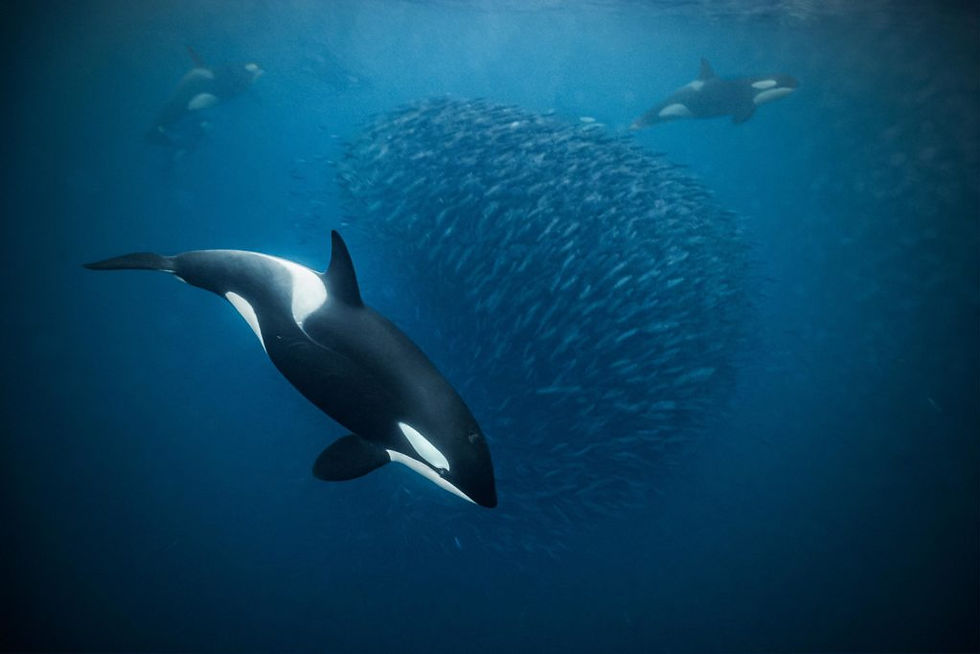
Striped marlin hunting massive schools of sardines, humpback whales on migration, orcas, dolphins, sea lions and sharks converging in the same place. Real, raw action in open ocean.
This guide is for anyone who wants to understand exactly what diving La Paz looks like, what Baja California Sur offers in autumn, and how this corner of Mexico is best experienced from the water.
La Paz: the heart of the Sea of Cortez
La Paz is the capital of Baja California Sur and the base of operations for diving in the southern Sea of Cortez. It's a small, unhurried city with a long waterfront promenade, outstanding food and a Mexican culture that feels genuinely present at street level. But what makes it special is what lies below the surface.
The Sea of Cortez is one of the most biodiverse bodies of water on the planet.
More than 800 species of fish and a third of the world's cetaceans pass through it at some point in their lives. And unlike other destinations famous for large fauna, the dive sites here are just 30 to 60 minutes from the harbour by boat.
No liveaboard required, no full-day crossings. Each morning you go out, dive, eat and return to shore with time left to lose yourself in the city.
The optimal season runs from July to November, with warmer water, better visibility and peak pelagic activity in September, October and November.
The dive sites of La Paz
Los Islotes — curious sea lions
If La Paz has one iconic site, it's Los Islotes. A small rocky formation north of Isla Espíritu Santo, home to a stable colony of California sea lions. The juveniles are extraordinarily curious: they come down to greet you, bite your fins, circle the group and approach cameras as if they know they're being filmed.
It's one of the most memorable marine life interaction experiences anywhere in the world. You're not watching them from a distance — you're interacting with them. The dive sits at around 12 to 18 meters, conditions are generally calm, and it's suitable for Open Water divers with some experience.
Note: during pupping season (typically June to August) the site may have restrictions to protect the pups. Outside that window, the interaction is fully available.
Isla Espíritu Santo — pure biodiversity
Isla Espíritu Santo is a UNESCO Biosphere Reserve and National Park. It's the natural centrepiece of any trip to La Paz.
Its waters hold a concentration of life that genuinely surprises: reefs mixing Pacific tropical fish with endemic species, rocky floors full of moray eels, lobsters, angelfish, pufferfish, green and hawksbill turtles.
The island itself is one of the most striking landscapes in Baja: red desert cliffs dropping into turquoise water, untouched coves and a sense of remoteness that's hard to find this close to a city. Dives here combine abundant marine life with genuinely unique underwater scenery.
The wrecks of La Paz — history beneath the surface
La Paz has several accessible wrecks that have become artificial reefs with remarkable marine life.
The most famous is the Salvatierra, a ferry that sank in 1976 at around 18 meters depth and is now covered in coral, anemones, schools of jacks and turtles that have made it their home.
Wreck diving in La Paz has a particular appeal: these aren't ships you dive — they're ecosystems in their own right. The structure is barely recognisable beneath the life that covers it. It's diving with narrative: each wreck tells its own story, and the story of the sea that absorbed it.
Volcanic reefs and pelagic banks
Beyond the iconic sites, La Paz offers volcanic reefs with unique formations — cones, walls, small caverns — and zones known for encounters with large pelagics: hammerhead sharks in schools, oceanic manta rays, tuna, jacks and, occasionally, whale sharks at the surface.
These encounters depend heavily on currents and season.
They don't always happen — but when they do, the dives stay with you. Which is why we say that Baja isn't dived with expectations: it's dived with presence. Whatever the ocean decides to offer that day, that's what you live.
Sardine Run in Mag Bay — the pelagic safari
If La Paz is the soul of the trip, Mag Bay (Bahía Magdalena, on the Pacific side of Baja Sur) is the pure adrenaline.
Every year, between October and November, millions of sardines migrate in massive schools that attract one of the greatest feeding frenzies in the ocean:
Striped marlin hunting with coordinated precision — entering the school at extraordinary speed, compressing the sardines into a bait ball and striking
Humpback whales passing through on their southward migration, occasionally feeding with spectacular lunges
Sea lions hunting in coordinated groups
Common dolphins in pods of hundreds
Multiple shark species taking advantage of the remains
Occasional orcas — among the most sought-after sightings of the year
Seabirds diving from the air in vertical freefall
This is NOT scuba diving. It's open-ocean snorkelling with specific technique: you spot the activity from the surface (birds circling, water that "boils"), slip in with fins, mask and snorkel, and swim calmly to the edge of the action.
The marlin, the whales, the sea lions — they're there for the sardines, not for you. You observe and document.
It's one of the most extraordinary natural spectacles on the planet. Very few people have seen it in person. Those who have, don't forget it.
Our Baja California Sur trip includes 2 complete pelagic safaris in Mag Bay (with the option of a third). The logistics — transfers, local pangueros, safety briefings, reading the water — are coordinated alongside local operators who know the area, because doing this without people who know the place is complicated and, at worst, genuinely unsafe.
The oceanic mobula migration
There's another phenomenon, less well known but equally extraordinary, that occurs in Baja Sur: the mass migration of oceanic mobula rays (Mobula munkiana).
Every year between March and May, thousands — sometimes tens of thousands — of mobulas concentrate in the Sea of Cortez, forming dense groups that leap repeatedly out of the water, sometimes several metres high.
It's one of the only animals in the ocean that truly flies. Watching them in formation from a boat, with hundreds of individuals jumping all around you, is difficult to describe. Some scientists believe they leap to communicate, others to shed parasites, others simply because they can.
During October-November (our expedition dates) the mobulas aren't in mass migration, but individual oceanic mantas and mobulas can appear on any dive. The spring mass migration is a separate phenomenon entirely — one that deserves its own trip.
Marine life you can encounter
Here's what the ocean can offer in Baja Sur:
Sea lions (Los Islotes, year-round)
Hammerhead sharks (in schools, depending on currents and season)
Oceanic manta rays (encounters possible, not guaranteed)
Multiple shark species (reef, silky, occasional bull)
Striped marlin (Sardine Run, October-November)
Humpback whales (migration, October-March)
Orcas (occasional but present in the area)
Dolphins (common, bottlenose, spotted)
Green and hawksbill turtles (reefs and wrecks)
Schools of jacks, tuna and barracuda
Oceanic mobulas (individuals in autumn, thousands in spring)
Whale shark (snorkel, October-April in La Paz Bay)
One important note: none of these sightings are guaranteed. This is open ocean diving, not an aquarium. The essence of a Baja California Sur trip is precisely that: every day is different, every dive is an unexpected gift, and the surprise is part of the experience.
When to go: the Baja California Sur calendar
Month | What to expect |
March–May | Mass mobula migration, humpback and grey whales |
June–August | Warmer water, sea lions (with pupping restrictions), tropical marine life |
September–November | Peak pelagics, Sardine Run in Mag Bay, best visibility |
December–February | Cooler water, grey whales in Pacific lagoons, quieter diving |
💡 The October-November window is when we run our expedition because it combines three factors in the same week: still-warm water in La Paz, active Sardine Run season in Mag Bay, and the Día de Muertos celebration on 1-2 November — one of the most extraordinary cultural events in Mexico.
Level required and preparation
Baja California Sur isn't a beginner destination — but it's not Socorro either. Most dives in La Paz are well suited to Advanced Open Water divers, with manageable currents and depths between 12 and 30 meters.
What we recommend for this destination:
Advanced Open Water certification or equivalent
Minimum 20-30 logged dives, ideally with prior open-water experience
Good buoyancy control (marine life approaches when you're still)
Comfortable diving for 45-60 minutes at a time
Ability to complete 2-3 dives per day across multiple consecutive days
For the Mag Bay pelagic safaris, no dive certification is required — it's surface snorkelling — but good physical fitness, water confidence and the ability to swim with fins in some swell are essential.
Underwater photography in Baja Sur
Baja California Sur is a dream destination for underwater photography, particularly for wide-angle:
Sea lions at Los Islotes offer close, dynamic interaction — powerful compositions with subjects in constant motion
The wrecks allow dramatic side lighting and structural framing
The Mag Bay pelagic safaris are National Geographic-level scenes — marlin in bait balls, whales, sea lions mid-hunt
The light in the Sea of Cortez in autumn is warm and golden at the surface, intensely blue below
That's why our expedition includes a wide-angle underwater photography workshop led by Borja García (@Borjius_diver), professional underwater photographer and BTO co-founder. Not isolated theory — real-time feedback, pre-dive briefings, image reviews after each session.
Every participant also receives a personal underwater photography session during the trip, with professional shots taken of them below the surface to take home.
If underwater photography interests you beyond this trip, BTO's underwater photography Academy is currently developing a dedicated Lightroom CC editing course for underwater images. Coming soon.
Living Baja California Sur with Born to the Ocean
From 29 October to 6 November 2026, we're taking a small group to Baja California Sur. Nine days, eight nights.
Eight dives across the best sites in La Paz and two complete pelagic safaris in Mag Bay. An expedition designed for anyone who wants to experience the wild ocean without the trip feeling improvised.
The programme includes:
Diving: 8 dives in La Paz + 2 pelagic safaris in Mag Bay
Nature: Isla Espíritu Santo, La Balandra, desert and ocean landscapes
Culture: special Día de Muertos evening, national Whale Museum, Mexican gastronomy
Photography: wide-angle workshop + underwater portrait session + photography competition with prizes
Logistics handled: 4★ hotel with breakfast, daily transfers, expert local guides, full BTO coordination throughout
Small group: maximum 10 places
We're not a travel agency. We're divers and photographers designing expeditions we'd want to do ourselves. If you like what you've read and want to be part of this expedition, let's talk on WhatsApp. We reply within 24 hours.


Comments