
Diving in Komodo: where currents rule and life explodes

There are diving destinations that impress with water clarity. Others with coral. Others with marine life. Komodo impresses with all of that at once — and adds something that few places in the world can offer: the feeling that the ocean here still plays by its own rules.
Between the Flores Sea and the Indian Ocean, Komodo National Park is one of those places divers always mention when talking about the world's best destinations.
And it's not marketing. It's that when the Indo-Pacific current system converges in this volcanic archipelago of 29 islands, it creates something without comparison: cold, nutrient-rich water in the south, warm tropical water in the north, and in between, a density of marine life that's still hard to process after several days diving it.
This post is for understanding what makes Komodo special, what you'll find underwater, and how to plan a trip that does justice to what the place offers.
Why Komodo is different from everything else
The short answer is: the currents.
Komodo National Park sits at a point where the Pacific and Indian Oceans exchange enormous volumes of water. The differences in temperature, depth and salinity between the two systems generate currents that can be brutal — and that are simultaneously the reason there is so much life concentrated in such a small space.
The currents bring cold, nutrient-rich water from the depths. That upwelling feeds the phytoplankton, which feeds the zooplankton, which feeds the small fish, which feeds the large ones. It's the food chain in its purest form, visible on every dive: where there's current, there's life. And in Komodo, there's almost always current.
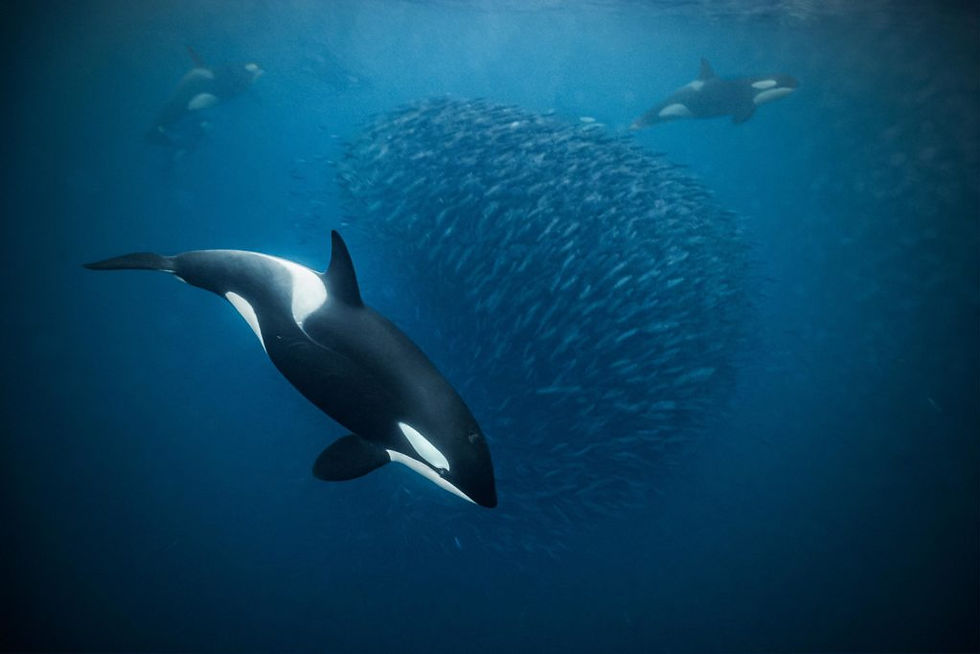
The result is an ecosystem that holds more than 1,000 species of fish, 260 species of coral, oceanic manta rays, multiple shark species, turtles, dolphins, occasional whales and a variety of macro life that rivals the best destinations in Indonesia. All within a UNESCO World Heritage National Park since 1991.
Komodo is also not just diving. The same islands that hold spectacular reefs are home to the Komodo dragon — the largest lizard in the world — and terrestrial landscapes of a beauty that many purely tourist destinations would envy: golden savannah hills dropping into turquoise bays, pink sand beaches and sunsets from viewpoints that leave you speechless.
The best dive sites in Komodo
Crystal Rock — organised chaos
If Komodo has one emblematic site, it's Crystal Rock. A volcanic pinnacle that rises from the seafloor at around 12 metres, surrounded by currents running in multiple directions, with an absurd concentration of life converging on it.
The dive format here depends entirely on the current. When it runs strong, divers hold onto the rock and watch as schools of jacks, grey reef sharks, Napoleon wrasse, barracuda and — if lucky — oceanic whitetip sharks pass by. When the current is gentler, the dive becomes a spectacular drift around the pinnacle, with the rock covered in orange soft coral and sea fans that seem to set the blue water alight.
Level: Advanced with current experience. Non-negotiable.
Castle Rock — sharks in current
A few minutes from Crystal Rock, Castle Rock is another seamount with a similar dynamic but its own character: this is where grey reef sharks gather in impressive numbers. Seeing 20, 30, on good days more than 50 individuals circling the formation — using the current to hold position effortlessly — is entirely normal here.
The dive requires a controlled descent in current, good positioning and considerable patience to stay still and let the life come to you. Those who move too much frighten the sharks and miss the scene.
Level: Advanced with current experience and blue-water descent skills.
Manta Alley — the manta salon
At the southern tip of the park, Manta Alley is where the destination shifts register entirely. The water is colder (18-22°C at times), soft coral is more abundant and the colour is different — deeper, darker blue, with sea fans in intense purples and reds.
Manta Alley is one of the most active manta ray cleaning stations in the world. Individuals arrive in groups — sometimes 10, 15, on extraordinary days more than 30 — and make slow circles above the coral heads where the cleaner fish wait. The sight of several oceanic manta rays spiralling above you, wings fully extended, is one of the most hypnotic experiences in all of diving.
Level: Open Water with some experience. Cold water and moderate-to-strong current are the only real challenges.
Batu Bolong — the most photogenic reef
If the previous sites are about action, Batu Bolong is about contemplation. A volcanic pinnacle with walls covered in soft coral in colours that seem unreal — orange, pink, purple, yellow — with a density of tropical fish that makes it hard to know where to point the camera.
It's the most photographed site in Komodo, and for good reason. Every centimetre of rock has something to see: nudibranchs on the sea fans, pipefish between the soft coral, scorpionfish camouflaged at the base, and the constant movement of enormous schools of colourful fish rotating around the pinnacle in the current.
Level: Open Water, though current at certain times may require experience.
Cannibal Rock — macro in its purest form
Cannibal Rock is the great surprise of Komodo's south route for anyone expecting only sharks and mantas. It's an extraordinary macro site: sea apples (brightly coloured holothurians that filter the water), rare nudibranch species, ghost pipefish (Solenostomus), pygmy seahorses on sea fans, and a variety of cryptic life that keeps the macro photographer occupied for hours.
The marine life you'll find underwater
Komodo is one of the most marine-biodiverse archipelagos on the planet:
Oceanic and reef manta rays: present year-round, highest concentration at Manta Alley
Grey reef sharks: the most common species, especially at Castle Rock and Crystal Rock
Whitetip reef sharks: on rocky floors and pinnacles
Nurse sharks: resting on sandy floors
Whale sharks: occasional sightings, more frequent in the north
Green and hawksbill turtles: at virtually every site
Napoleon wrasse (humphead wrasse): large individuals at Crystal Rock and Castle Rock
Schools of barracuda, jacks and dorado: in active current zones
Dolphins: frequently seen at the surface between dives
Whales: occasional sightings of sperm whales and fin whales
Macro life: rhinopias, ghost pipefish, pygmy seahorses, nudibranchs, scorpionfish, ribbon eels
Komodo's currents: what you need to know before getting in
Komodo's currents are not like the currents you know from other destinations. Here they can change direction, speed and intensity within minutes, without warning, and in some zones create phenomena such as pronounced thermoclines, washing-machine currents (that push you in all directions simultaneously) and sudden cold-water upwellings that completely transform dive conditions.
This is not a destination to improvise at. You always dive with a local guide who knows the sites and the tides. The briefing before each dive is not a formality — it's critical information about which direction the current is running, where the sheltered areas behind the rocks are, and what the pick-up point is if the group separates.
Basic rules for Komodo:
Never move away from the group without signalling the guide
Carry your own DSMB (surface marker buoy) — mandatory at many sites and always necessary
Don't fight the current — use it or find shelter behind the rock
Air consumption increases significantly in current — adjust your planning accordingly
5mm wetsuit for the south route (Manta Alley, Cannibal Rock) — water can drop below 20°C
When to go: north route vs south route
Komodo divides into two routes with completely distinct characteristics:
North Route (Crystal Rock, Castle Rock, Batu Bolong):
Best season: April to November (dry season, best visibility, warmer water)
Water: 26-29°C
Visibility: up to 30 metres on good days
Star fauna: sharks, pelagics, large schools
Currents: strong and demanding
South Route (Manta Alley, Cannibal Rock):
Best season: year-round, with peak mantas January to April
Water: 18-24°C
Visibility: variable, lower than the north
Star fauna: manta rays, extreme macro, spectacular soft coral
Currents: moderate, more predictable
May — when we run our Wild Current expedition — is the transition between the north at its best and the south still active. One of the most complete windows of the year.
Level required: is Komodo for beginners?
The honest answer: it depends on the site, but generally no.
The most famous sites (Crystal Rock, Castle Rock) require Advanced Open Water with real current experience and a minimum of 50 logged dives, preferably with some prior experience in moving water. It's not recommended as a first diving trip outside the Mediterranean.
That said, in our expedition we aim to balance the programme: more demanding dives at the challenging sites alongside more accessible options (Batu Bolong in lower current, some south route zones) for divers with less current experience.
If you have doubts about whether your level is sufficient, let's talk — it's one of the most common conversations before this type of trip and it's always better to have it early.
Komodo above the water: dragons, tribes and Padar
Diving Komodo without getting out of the water would mean missing half the trip.
The Komodo dragon (Varanus komodoensis) is the largest lizard in the world — it can exceed 3 metres in length and 70 kg in weight — and it still lives freely on the islands of the park. Trekking with a specialist guide on Komodo or Rinca to observe them in their natural habitat is one of those experiences that simply doesn't exist anywhere else.
Padar Island has one of the most photographed viewpoints in Indonesia: a volcanic ridge from which three bays of different colours are visible — turquoise, emerald green and deep blue. The ascent is a 20-minute walk and the view justifies every step.
The Wae Rebo tribe (an option in our expedition) is a Manggarai village in the mountains of Flores, accessible only on foot, which preserves its traditional conical-house architecture and a way of life almost untouched by the outside world. Spending a night there — with dinner, breakfast and accommodation with the local community — is one of those experiences you remember with greater intensity than any dive.
Diving Komodo with Born to the Ocean
From 16 to 25 May 2027 we're taking a small group to Komodo National Park on the Wild Current expedition. Ten days designed to do justice to what this destination offers: the five iconic sites, guaranteed fauna in the best month of the season, local culture unlike anything you've experienced, and wild nature from the moment you land.
The programme includes:
Diving: 15 dives at Crystal Rock, Castle Rock, Manta Alley, Batu Bolong, Cannibal Rock and more
10 days / 9 nights in double room with private bathroom and A/C
Full breakfast included every day
2 underwater photography workshops: wide-angle with Borja García (@borjius_diver) and macro with Santi Tinoco (@santi.tinoco)
Personal professional underwater photography sessions for every participant
Complete dive equipment included
Photography competition with prizes for the winners
Night herping for snakes with a specialist guide
Excursion to Komodo National Park — dragons in their habitat
Night with the Wae Rebo tribe (optional) — an experience few diving expeditions include
Komodo National Park fees
Water, coffee, tea and post-dive food on the boat on diving days
Airport — accommodation transfer return
Exclusive BTO Komodo 2027 t-shirt
Full BTO staff accompaniment throughout the trip
From 1,850 € (international flights not included). Places in pre-reservation — the group has a maximum number of spots and demand has already begun.
We are a team of divers and photographers who design expeditions we'd want to do ourselves. Komodo is the most technically demanding destination we've organised to date — and that's precisely why it deserves the level of preparation and accompaniment we put into it.
If you like what you've read and want more information about Wild Current, let's talk on WhatsApp. We reply within 24 hours.
Thank you for reading all the way to the end. We hope you enjoyed the post.
See you in the blue! 🤿

Isla de Komodo 
Dragón de Komodo 
Paisaje de aguas cristalinas en Lambuan Bajo 
Nudibranquios de la isla de Komodo 
Arrecife de coral de Komodo 
Manta Oceánica de Komodo


Comments