
Why we don't manufacture stock: the reason behind our sustainable clothing

There's a question we get asked often when someone discovers the BTO shop:
"Why does my t-shirt take a few days to arrive?
Why don't you have stock like any other shop?"
The short answer is: because that wait of a few days is exactly what stops your t-shirt from ending up in a landfill before it's even sold.
The long answer is this post.
The problem most people don't see
The fashion industry is, according to various sector analyses, the second most polluting industry on the planet. And the main reason isn't just what gets made — it's how much gets made without real need.
The traditional model works like this: a brand produces thousands of units of a garment before knowing how many will actually sell. It manufactures based on forecasts, seasonal trends, and what the market "probably" wants.
The result is a constant mismatch between what's produced and what's actually needed — a mismatch the industry has a name for: overproduction.
The real numbers behind that mismatch
These aren't abstract figures. They're data published by organisations like the European Parliament, the World Bank, and scientific reviews of the textile sector:
The fashion industry generates between 8% and 10% of global CO₂ emissions, more than all international flights and maritime shipping combined.
It consumes around 93 billion cubic metres of water a year. A single conventional cotton t-shirt can require more than 2,000 litres of water in its manufacturing process.
It is responsible for up to 20% of the world's industrial wastewater — contaminated with dyes, bleaches and chemicals that in many cases are discharged untreated into rivers and oceans.
Textile manufacturing generates roughly 92 million tonnes of waste a year — clothing that was never sold, factory surplus, discontinued collections that end up incinerated or in landfill because destroying them is cheaper than storing them indefinitely.
Synthetic fibres like polyester account for up to 35% of the microplastics polluting our oceans — particles shed with every wash that no water treatment system fully filters out.
Every one of those figures has something in common: they describe the environmental cost of making clothes that, in large part, were never actually used by anyone.
The damage is already done the moment the garment leaves the factory — whether someone ends up wearing it or not.
Why we chose to produce only on demand
At Born to the Ocean, we decided from the start that we weren't going to take part in that model. And the decision wasn't just ethical — it was also consistent with what we represent as a brand.
We don't manufacture a single garment until someone orders it.
When you buy a t-shirt, a rash guard or any garment from our shop, that order is what triggers the manufacturing.
There's no garment of yours sitting in a warehouse for months. There's no surplus of your size piling up in an industrial unit. There is only the garment you chose, made specifically for you.
This has direct, measurable consequences:
Zero stock means zero waste from overproduction. There's no factory surplus. There are no discontinued collections that need to be liquidated or destroyed. Every garment manufactured already has, from the moment it's produced, a destination and an owner.
The environmental cost matches actual demand exactly. The water, energy and materials invested in making each garment correspond exactly to the garments people actually want and will use — not to an estimate that may or may not turn out right.
There are no "clearance sale" discounts. That kind of sale, so common in conventional fashion, is actually visible proof that too much was made. We don't have them because we don't generate that kind of surplus to clear.
It's not just how much we make — it's also how and with what
Producing on demand solves the overproduction problem.
But we wanted to go a step further too, in the materials and in who physically manufactures each garment.
Materials with a genuinely lower footprint.
A large part of our garments are made with organic cotton — grown without the synthetic pesticides and fertilisers used in conventional cotton, one of the crops that consumes the most water and chemical inputs on the planet — and with recycled fibres, which reintroduce existing textile material into the production cycle instead of extracting virgin raw material.
Manufacturers with strict environmental protocols.
We work with production facilities that apply processes specifically designed to reduce pollution and waste: lower water consumption per garment, lower-impact dyes, and controlled management of the waste that any textile manufacturing process generates, however small.
The unexpected consequence: better quality, not worse.
When a garment is manufactured under more careful protocols — with higher-quality fibres and processes that are gentler on the fabric itself — the result is a more durable, longer-lasting garment than one that comes off a mass-production line optimised purely to cut costs and maximise volume. Overexploitative fashion doesn't just do more damage to the planet — it also generally produces a shorter-lived product.
This isn't a coincidence. It's the logical consequence of investing in the process instead of investing in volume.
Making every garment mean something real
Beyond how it's made, there's the question of what's made.
Every BTO shop collection is inspired by a real marine ecosystem — reefs, large pelagic species, underwater caves, microscopic life.
We don't follow seasonal trends or fashion calendars.
Every print is designed by us, specifically to represent a species or habitat we've dived with and want people to know about.
This means two practical things:
You won't find these designs anywhere else.
They're not generic templates or recycled stock prints from a catalogue — they're illustrations created specifically to represent what we've seen underwater.
Every garment has a purpose beyond aesthetics.
Wearing a BTO piece is, in practice, directly supporting our marine conservation work — the same work that sustains the projects linked to the Adopt a Coral section within the shop itself.
What this model means for you as a buyer
Choosing clothing made on demand isn't just an abstract responsible-consumption decision.
It has concrete implications you may not have considered:
Your purchase doesn't contribute to a surplus someone will have to destroy later.
When you buy something made on demand, that "something" doesn't have an unsold twin waiting in a warehouse in your exact size and colour.
You need a bit of patience — and that's fine.
On-demand production takes longer than pulling a garment off a shelf. That wait is exactly the price of nothing being overproduced so you can have your garment "instantly".
You're voting with your money for a different model.
Every on-demand purchase is a signal that there's a real market for fashion that doesn't compete on delivery speed but on the sense behind what it produces.
This isn't greenwashing — it's a structural decision
It's easy for any brand to say it "cares about the planet". What separates a statement from a real decision is whether that statement changes how things are done, not just how they're talked about.
Producing on demand is slower, logistically more complicated, and probably less profitable in the short term than having stock ready to ship within 24 hours.
We chose it anyway because it's consistent with everything else we do at Born to the Ocean: small-group diving expeditions designed to minimise impact at destinations, a coral adoption programme that funds real restoration work, and now, a shop that generates no unnecessary textile waste and doesn't compromise on materials what we already demand from the rest of the brand.
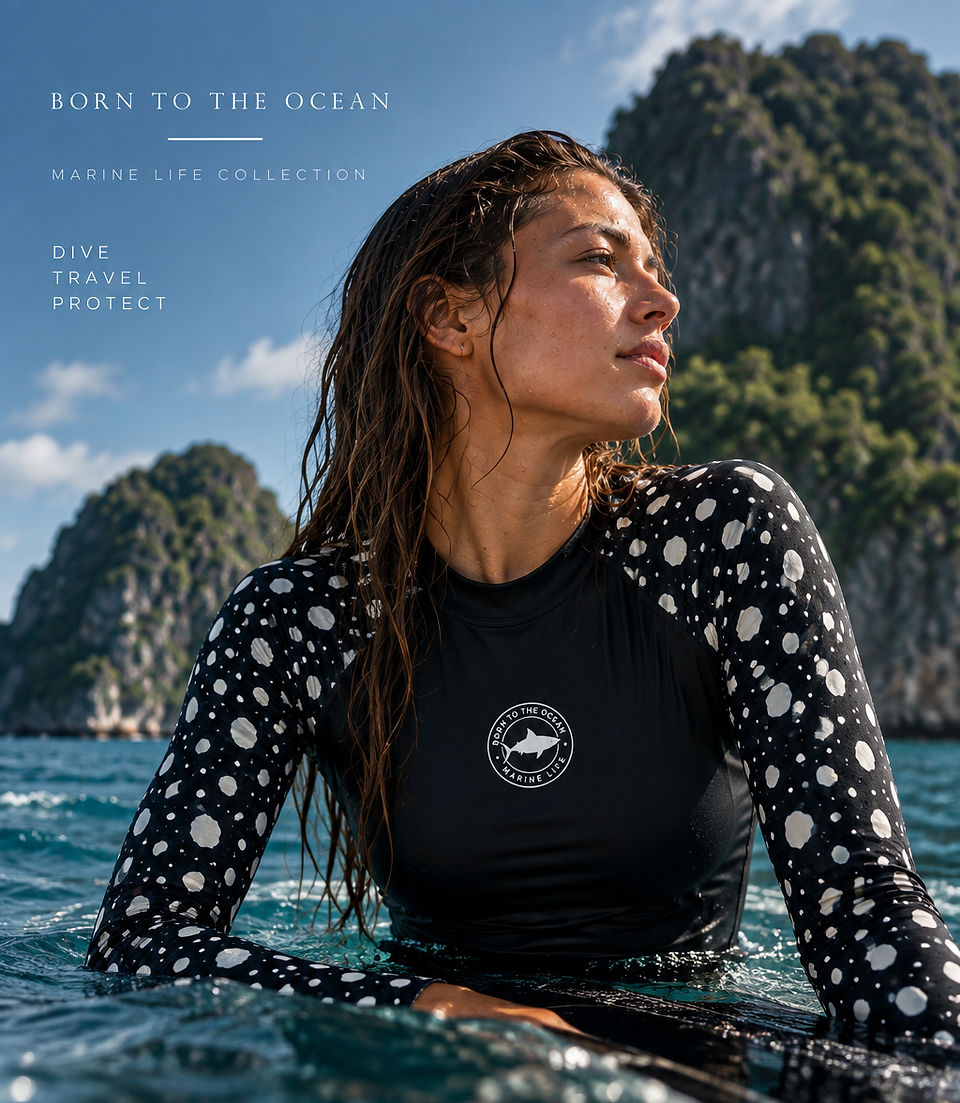
Dive, travel, protect isn't just the slogan we print on a t-shirt. In this specific case, it's the actual reason that t-shirt is made the way it's made, with the materials it's made with.
If you want to see the collections and what each one represents, you can visit the BTO shop.
And if you have any questions about materials, sizing or the production process, let's talk on WhatsApp. We reply within 24 hours.




Comments