
Playa del Carmen mangroves: why they are key to the reef

When people think of Playa del Carmen, they think of beaches, reef, cenotes and, if you’re a diver, the bull shark. Almost nobody thinks of the mangrove: that tangled forest of roots at the water’s edge that many see as “scrub” that can be filled in for construction.
And yet much of what divers come to see depends on it. Mangroves are one of the most important and most threatened ecosystems of the Riviera Maya, and understanding what they do explains a lot about what happens underwater.
In this article we tell you which species grow here, what functions they perform, what the situation is in Quintana Roo and what you can do to help protect them.
What is a mangrove (and why it isn’t “a tree in the sea”)
A mangrove is a forest of trees adapted to live with their roots in salt or brackish water, in the strip between land and sea. Mexico has four species, and all four are protected under the country’s regulations:
Species | How to recognise it | Where it usually grows |
Red mangrove (Rhizophora mangle) | Arching aerial roots, like stilts | On the front line, next to the water |
Black mangrove (Avicennia germinans) | Vertical rootlets sticking out of the mud to breathe; crystallised salt on the leaves | In more inland, saltier zones |
White mangrove (Laguncularia racemosa) | Rounded, paler leaves | In intermediate zones, somewhat higher up |
Buttonwood (Conocarpus erectus) | Fruits shaped like small buttons | In the transition to dry land |
The exact distribution changes with salinity and terrain, but the idea is the same: each species occupies its own strip, and together they form a living barrier between the sea and the jungle.
What a mangrove does for you (even if you can’t see it)
1. It’s the reef’s nursery
Many reef fish spend their childhood among the mangrove roots, where predators can’t easily reach. Snapper, grunts and juvenile lobsters grow up there until they’re big enough to move out to the reef.
The science backs this up. A Caribbean-wide study concluded that, in general, the larger the mangrove forest, the higher the density of the fish that use it as a nursery on nearby reefs. Another study found that the juveniles of at least 17 Caribbean reef fish species are associated with bays containing mangroves and seagrass beds, and that they’re missing from bays without them.
2. It slows storms and erosion
The roots reduce wave energy and hold sediment in place. On a coast exposed to hurricanes, like the Mexican Caribbean, it’s a natural defence that costs nothing to build or maintain. The erosion of Playa del Carmen’s beaches has several causes, both natural and human, but the loss of mangrove is one of those that are pointed to.
3. It filters before the water reaches the reef
The mangrove traps sediment and part of the pollutants in the water coming from land, which benefits the reefs and seagrass beds in front of it.
4. It stores carbon
Much of a mangrove’s carbon ends up locked in the waterlogged soil, where it can stay for a very long time. When the mangrove is destroyed, that carbon goes back into the atmosphere.
5. It shelters far more life
Birds, crustaceans, reptiles and mammals depend on it to nest, feed or take refuge.
The connection: jungle, cenote, mangrove and reef
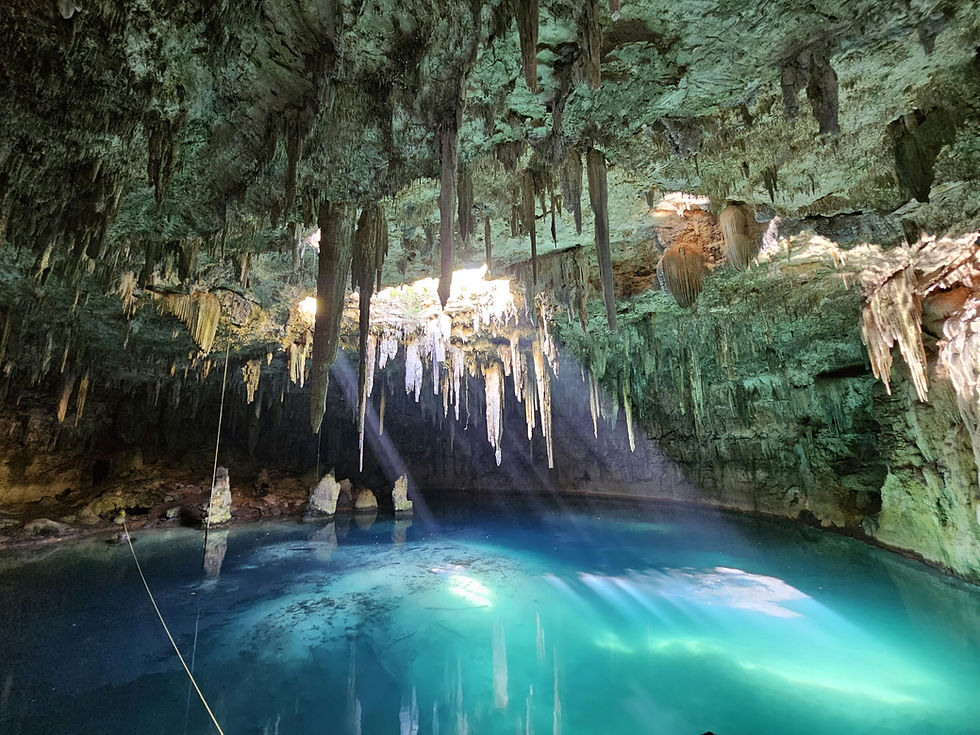
The Riviera Maya works as a connected system. Rainwater seeps through the limestone, flows through the cenotes and the underground aquifer, reaches the coastal wetlands and mangroves and empties into the Mesoamerican Reef System, the second-largest barrier reef on the planet.
The mangrove sits right at the junction. In fact, Mexican law recognises it: it expressly protects the interactions between the mangrove, the dune, the adjacent sea and the corals.
That’s why, according to local environmentalists, when mangrove is lost along the coast the effect doesn’t stay on land: the water and the reef end up feeling it.
How much mangrove is left: the data
Data point | Figure | Source |
Mangrove in Mexico (2020) | 905,086 hectares | Conabio |
Mangrove in Mexico (2025) | 877,464 hectares | Conabio |
Net loss 2020-2025 | 27,622 hectares | Conabio |
Disturbed mangrove (dead or regenerating) | 52,130 hectares | Conabio |
Mexico’s world ranking by mangrove area | 4th | Conabio |
Impact in Quintana Roo (2020-2025) | 12,927 hectares | Conabio data reported in the press |
Northern Quintana Roo (over 40 years) | From 3,429 to 1,569 hectares (−55%) | Biologists and environmentalists in the region |
A couple of caveats for reading these figures properly:
Conabio clarifies that a reduction in area doesn’t always mean disappearance: part of the mangrove becomes “disturbed” and part migrates inland as sea level rises.
Figures and methodologies vary between sources and periods, but the trend they all point to is the same.
The most striking thing about northern Quintana Roo, which includes Cancún, Playa del Carmen, Puerto Morelos and Tulum, is the fragmentation. According to experts, it went from around 30 mangrove fragments in 1976 to 167 in 2011, because construction kept splitting the forest into smaller, less functional pieces.
Playa del Carmen’s mangroves today
Playa del Carmen still has a strip of mangrove, though small and under pressure. According to local environmentalists, the city’s last remnants are concentrated in the area between CTM Avenue and Punta Esmeralda, and in areas like Playa Mamitas, where environmental groups have raised concerns about the risk posed by planned residential projects on dunes and mangrove.
Local groups are also asking for around 80 hectares of the city’s mangrove to be declared a Protected Natural Area, as local media have reported.
The problems environmentalists point to keep repeating:
Real estate and hotel development on mangrove land.
Fragmentation of the forest by construction and roads.
Wastewater reaching the subsoil, cenotes and ultimately the reef, due to a lack of drainage infrastructure.
There is also good news. Organisations such as CEMDA have won favourable rulings in mangrove protection cases in Quintana Roo. In the Malecón Tajamar case in Cancún, a court ordered the affected mangrove area to be restored.
What the law says (and why it needs to be enforced)
Mexico has a solid protection framework on paper:
General Wildlife Law, Article 60 TER (in force since 2007): prohibits removing, filling, transplanting or pruning mangrove, or carrying out any work that affects the mangrove’s hydrological flow, its natural productivity or its interactions with the dune, the sea and the corals. The only exceptions are activities for protection, restoration, research or conservation.
Federal Penal Code, Article 420 bis: punishes with two to ten years in prison and a fine anyone who illegally damages, drains or fills mangroves and other wetlands.
NOM-022-SEMARNAT-2003: sets the conditions for preserving and restoring coastal wetlands in mangrove areas.
NOM-059-SEMARNAT: lists the mangrove species among protected species.
The problem, as environmental organisations themselves point out, is that rules alone haven’t eliminated the threats. What’s needed is monitoring, real enforcement and citizens who report violations.
What you can do
You don’t need to be a scientist or live in the Riviera Maya to help:
Visit mangroves with authorised local guides, without stepping on the roots or cutting branches. Areas such as the Sian Ka’an Biosphere Reserve are visited with authorised operators.
Don’t leave any waste. Plastic stays trapped among the roots for years.
Choose accommodation and operators that respect wetlands and don’t build on them.
Report to Profepa any filling, felling or clearing of mangrove you see.
Support restoration. Any contribution to local conservation and restoration projects adds up.
Look after the reef. It’s the other side of the same coin. If you want to contribute something concrete, our article on what dead coral is telling us explains how the Adopt a Coral programme works.
Echoes of Waters: the Riviera Maya below (and above) the water
On our Echoes of Waters expedition we don’t dive inside the mangrove, but we do dive in the system that depends on it: the Caribbean reefs of the Riviera Maya, Cozumel, the cenotes and, with luck, the bull shark. That’s why we think it matters for anyone coming to dive to also know what holds all this up from the shoreline.
Dates: 29 January to 7 February 2027 (10 days and 9 nights).
Diving: 13 dives across cenotes, reefs, Cozumel and the C56 wreck, with the chance to dive with bull sharks (not guaranteed).
Photography: an ambient photography workshop with Borja and a photo session for every participant in the cenotes.
Small group, accompanied by Born to the Ocean throughout the trip.
Accommodation: 3* hotel in a double room.
Level: recreational diving certification, with good buoyancy and control underwater.
From €1,800 (flights not included).
You can see all the details on the Playa del Carmen trip page. And if you’d like to get to know the destination better before deciding, we have our guide to diving the Riviera Maya cenotes and the article on the Playa del Carmen bull shark.
If you have any questions, message us on WhatsApp and we’ll reply within 24 hours.
Dive, travel, protect. 🤿


Comments