
Bull shark: the misunderstood king of the Mexican Caribbean

Few animals in the ocean carry a reputation so far removed from reality as the bull shark.
It's called aggressive, unpredictable, one of the "most dangerous sharks to humans" in every sensationalist ranking that circulates online.
And yet, every winter, hundreds of divers travel to Playa del Carmen specifically to get in the water with it — and come out of that dive with one of the most respectful and controlled experiences that exist in diving with large predators.
The gap between the myth and the reality is exactly what this post is about.
Who the bull shark really is
The bull shark (Carcharhinus leucas) is one of the few shark species capable of living in both salt and fresh water — it can swim far up rivers, and individuals have been documented hundreds of kilometres upstream in the Amazon and the Mississippi.
That unique physiological ability, combined with its stocky body and short, wide snout, gives it a solid, thickset look that contrasts with the sleek elegance of other shark species.
It can reach 3.5 metres in length and exceed 300 kilos. It is an opportunistic predator — feeding on fish, rays, turtles, crustaceans and occasionally smaller sharks — and its presence in shallow coastal waters, close to areas where it coexists with human activity, is precisely what has fuelled its reputation.
But reputation and real behaviour are two different things.
The myth of the dangerous shark — and what the data actually says
The bull shark often appears on lists of species "responsible" for the most incidents with humans, alongside the great white and the blacktip shark. That statistic, taken out of context, has built a reputation that doesn't match what happens in the vast majority of encounters.
What those lists don't explain is the context: documented incidents almost always occur in murky water, close to shore, in fishing or surfing zones where the animal mistakes the silhouette of a person for its usual prey — not in planned diving encounters, with clear visibility, where the shark identifies exactly what it's looking at.
Over more than a decade of organised bull shark dives in Playa del Carmen — hundreds of encounters every season, with thousands of divers over the years — the behaviour pattern observed is consistent: curious animals that approach to investigate, that circle around the group, and that in the vast majority of cases don't even make physical contact.
When something happens with that frequency and that consistency, it stops being luck. It's behaviour.
What makes the encounter safe isn't that the animal is "tame" — it's a wild predator and is treated as one. What makes it safe is the protocol: a thorough briefing before entering the water from guides specialised in this type of encounter, controlled group behaviour, a guide constantly reading the animals' behaviour, no flash or video lights to avoid disturbing them, controlled descents to the site along a guide line, and a whole set of safety measures for the divers.
Why they arrive in Playa del Carmen every winter
Between November and March, pregnant female bull sharks gather in the waters off Playa del Carmen. The reason the scientific community favours is that these waters offer favourable conditions for gestation — stable temperature, available food, and relative protection from larger predators.
The peak of the season arrives between January and February, when the concentration of individuals is highest and the chances of an encounter with several animals on the same dive are greatest. It is exactly the window that coincides with our Echoes of Waters expedition.
Dives generally take place between 20 and 30 metres depth, over a sandy bottom, with no reef structure to distract attention — the site is specifically designed to minimise interference and maximise visibility of the animals' behaviour.
What the dive is really like
The group descends and settles on the bottom, in a semicircle, following the guide's instructions. There is no chasing, no moving toward the animal — the protocol is exactly the opposite: the group stays still and compact, and it is the sharks that decide whether to approach or keep their distance.
What happens from there varies day to day. Some days a single individual makes a couple of passes and moves off. Other days, several females circle throughout the entire dive, crossing between the divers with that characteristic slowness that makes the animal look even larger than it already is.
The feeling most divers describe after their first encounter isn't fear — it's a mix of respect and surprise at how unhurried the behaviour is. The bull shark isn't looking for the diver. It simply shares the space, investigates with moderate curiosity, and continues its routine.
Why this is a conservation experience, not just an adrenaline one
The bull shark is classified by the IUCN as Near Threatened, with declining populations in several regions of the world due to overfishing and the loss of coastal habitat — precisely the estuaries and mangroves where the species completes part of its life cycle.
Every responsibly run bull shark diving expedition serves a function beyond the individual encounter: it generates a real economic incentive for the local community to protect the species rather than seeing it as fishing competition or a threat to be killed.
A live bull shark, visited by divers year after year, is worth far more to the local economy than a bull shark caught once.
That is the underlying logic that sustains well-managed shark diving tourism around the world — and Playa del Carmen is one of the places where it has worked best.
Over recent decades, photo-identification projects have emerged where, thanks to the work of local photographers, we know which females return each season, their condition, their scars and skin patterns. Each one has her own name. And thanks to that, we know, for example, that some individuals have been returning every year for more than two decades.
Experience the bull shark with Born to the Ocean
On our Echoes of Waters expedition to Playa del Carmen and the cenotes of the Riviera Maya, the bull shark encounter is one of the central dives of the programme — precisely because we coincide with peak season.
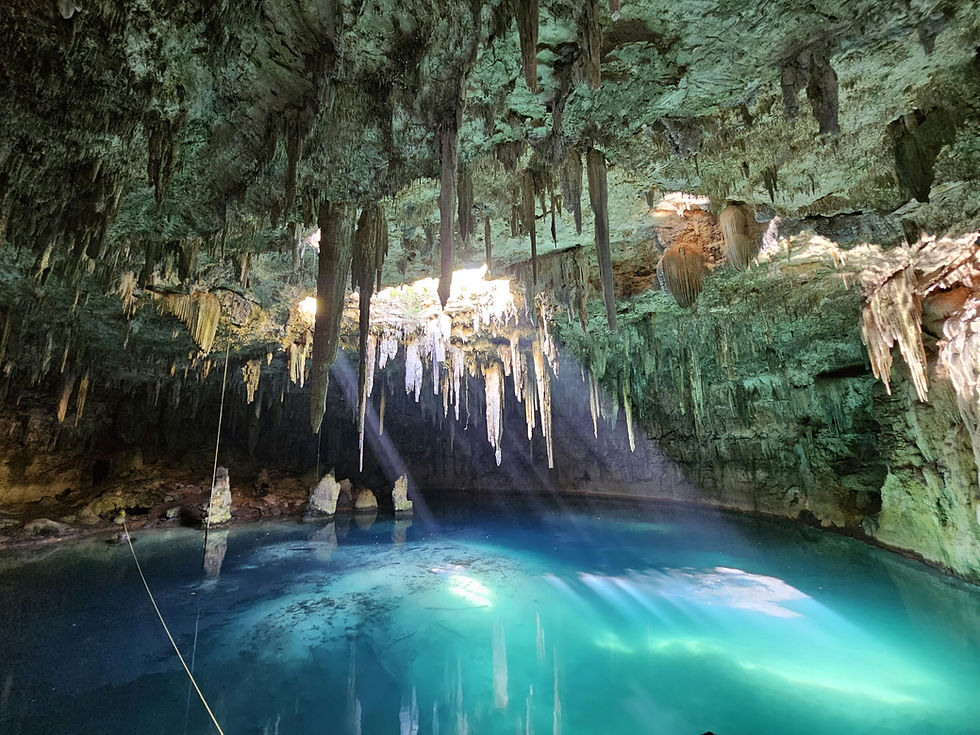
The trip combines 13 dives across two completely different worlds: the open sea of Playa del Carmen and Cozumel — with bull sharks, eagle rays, turtles, barracuda and groupers — and the underground caverns of the Riviera Maya cenotes, with their ambient photography and unique macro life. Two opposite ecosystems in a single trip.
The programme also includes a free day with the option to visit Chichén Itzá or the ruins of Cobá, and coincides with the Playa del Carmen Carnival — a real opportunity to connect with local culture from the inside, not just from the water.
The underwater photography workshop, led by Borja García (@borjius_diver), is specifically focused on the trip's two settings: ambient and light photography in cenotes, and action photography with bull sharks in open water. Each participant receives personalised sessions and leaves with their own professional images from the trip.
If you want to experience the bull shark encounter during its exact season, with a responsible protocol and a small group, let's talk on WhatsApp. We reply within 24 hours.


Comments