
Diving in Coiba, Panama: the sanctuary where humpback whales give birth.

There are destinations that are famous. And there are destinations that almost no one knows, not because they aren't worthwhile, but because something protected them from the world for decades.
Coiba is the latter. The largest island in Central America has been protected since 1919. Not by a national park, not by environmental awareness, not by activists. By a prison.
For 70 years, Coiba Island was a Panamanian penal colony.
Under the dictatorships of Torrijos and Noriega, it was one of the most feared detention centers on the continent,
a site of torture, executions, and disappearances. No one approached it voluntarily. Fishermen avoided its waters. Tourists were nonexistent.
The result, from a radically different perspective, was extraordinary: 80% of the island remained completely untouched.
The coral reefs grew without human pressure for decades.
The marine life thrived without fishing, without mass diving, without pollution.
When the prison closed in 2004 and UNESCO declared Coiba National Park a World Heritage Site in 2005, scientists encountered something that no longer exists in the rest of the Pacific: a benchmark marine ecosystem, almost untouched, which today serves as a point of comparison for understanding what all the reefs were like before we arrived.
They call it the Galapagos of Panama. That's no exaggeration.
Why Coiba Is Different From Anything You've Dived
The difference begins with geography.
Coiba National Park is located in the Gulf of Chiriquí, in the Panamanian Pacific, protected from the effects of El Niño and the cold northerly winds.
This privileged position creates a climatically stable zone that has allowed the coral to grow with a consistency that no longer exists in other reefs of the Eastern Pacific.
But what makes Coiba truly unique is not just the coral.
It's the intersection of currents.
The Gulf of Chiriquí is at the crossroads of the cold, nutrient-rich currents coming from the south—the same ones that feed the Galápagos—and the warm tropical waters from the north.
This combination generates local upwelling that pumps nutrients from the depths and sustains a food chain of unparalleled richness in the Central Pacific.
The result: 800 species of fish, 33 species of sharks and rays, and 20 species of cetaceans recorded in the park. And between August and October, the phenomenon that makes Coiba one of the most extraordinary destinations on the planet occurs: humpback whales arrive to give birth.
The phenomenon that makes August unique: humpback whales
This is something no other diving destination in the world offers in this exact way.
Every year, between July and November, humpback whales (Megaptera novaeangliae) migrate from their feeding grounds in the South Pacific to protected tropical waters to breed.
And the calm, warm, and slow-moving waters of the Gulf of Chiriquí are one of the chosen locations for something even more extraordinary than mating: the birth of their calves.
Pregnant females arrive in the shallow, protected waters of Coiba to give birth. The calves are born in these waters. The first weeks of a humpback whale's life are spent on the same reefs where we will dive.
This has unique implications for the underwater encounter. Mothers with young calves remain in shallow waters—between 5 and 25 meters—closer to the surface than in any other migratory context. The sound of whales, those songs that resonate for miles around, can be heard underwater during dives to the nearby reefs.
Sighting them with their calves, their first leaps, their first breaths... It's a privilege that can be experienced in few places on the planet.
And where there are humpback whales with calves, there's a predator that takes advantage of the situation: killer whales (Orcinus orca) approach the waters of Coiba, attracted by the presence of the calves. Sightings of orcas in transit are a real possibility—not guaranteed, but documented—during the dates of our expedition.
The Wildlife You'll Find Underwater
Coiba isn't just whales. It's a catalog of wildlife that's hard to believe exists in a single park:
Sharks — The Destination of the Great Predators
Coiba National Park is one of the last refuges of the bull shark (Carcharhinus leucas) in the Central Pacific. They patrol the park's pristine reefs permanently — they aren't seasonal visitors, they're residents.
The encounters are natural, without bait, without cages: the sharks share the reef with divers as part of their normal ecosystem.
The tiger shark (Galeocerdo cuvier) is also present — one of the most sought-after sightings in the diving world. Large, unmistakable, with that broad head and striped flanks that give it its name.
The encounters in Coiba are real encounters: the animal in its territory, doing what it does, without any kind of artificial setup.
Hammerhead sharks (Sphyrna lewini) appear in the Contreras Archipelago—although August is not the peak of their season, the presence of solitary individuals or small groups is a real possibility.
The park is part of this species' migration corridor along the Eastern Pacific.
Mantas and eagle rays—the lords of the reef
Mantas and eagle rays (Aetobatus narinari) are common in the park's nutrient-rich currents.
Eagle rays often appear in large congregations over the reefs; thirty or forty individuals flying in formation is a truly memorable sight.
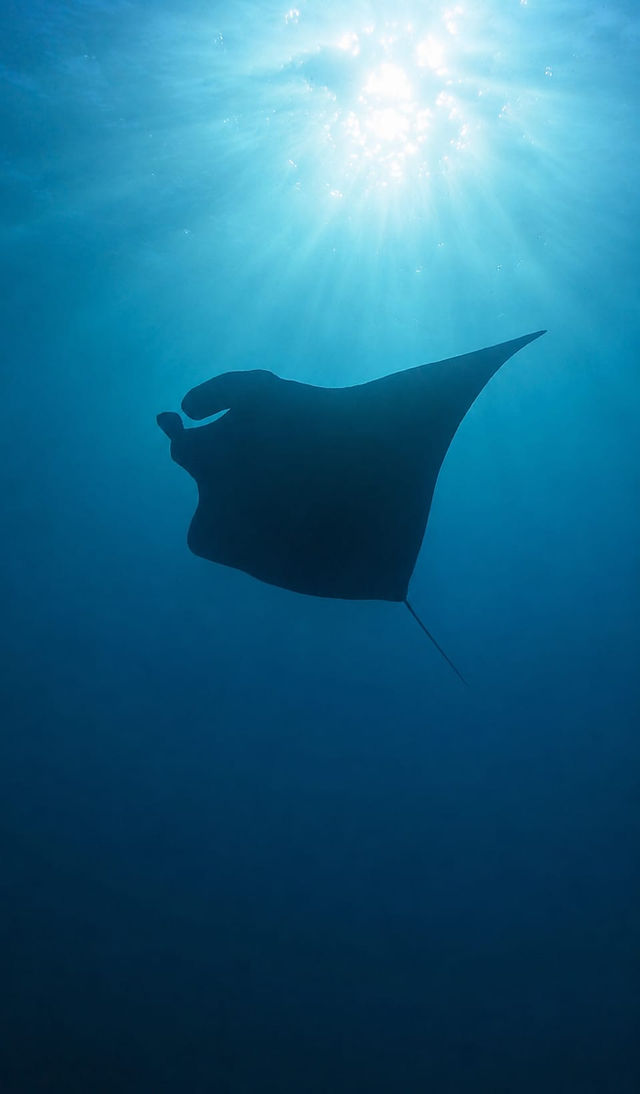
Mantas arrive at the cleaning stations with that characteristic elegance that leaves all divers speechless.
Humpback whales and their calves—a unique spectacle
We already mentioned this above. But it bears repeating: arriving during the exact season when humpback whales give birth in the shallow, protected waters of the Panamanian Pacific is something no other diving destination in the world can offer in this way.
Turtles, schools of fish, and reef life
Green and hawksbill turtles on virtually every dive. Huge schools of barracuda and jackfish in the active currents.
Reef life that, in the rest of the Pacific, no longer has the density seen at Coiba; the intact coral harbors a diversity of fish reminiscent of reef photographs from fifty years ago.
⚠️ Important note: Encounters with wildlife are never guaranteed. Nature and the ocean are unpredictable. What we do guarantee is arriving at the right time, with the right guides, at the right spots.
Santa Catalina: The Base of Operations
Diving in Coiba is done from Santa Catalina—a small town of surfers and divers on the Pacific coast of Veraguas, about 4-5 hours from Panama City.
It's not a mass tourism destination. There are no large chain hotels, no boardwalk packed with tourists. Santa Catalina is a town of just a few streets, surf breaks that attract surfers from all over the world, authentic local food, and the gateway to the park.
The Base: Hotel Boutique Nativo
A boutique retreat facing the Pacific Ocean. Double rooms with private bathrooms and air conditioning, its own restaurant, and a pool with ocean views.
Designed for relaxing between intense days of diving—not for those seeking resort luxury, but for those who want real comfort without missing the essence of the place.
Arrival: Crowne Plaza Panama City
The first night—after the international flight—the group stays at the Crowne Plaza Airport Hotel in Panama City. Double room with private bathroom and breakfast included. No logistical complications: you arrive, you rest, and the next day we start.
Beyond the Water: The Nature of Veraguas
The free day before your return flight isn't a wasted day; it's an opportunity to discover that Coiba and its waters are just one part of an extraordinary natural environment.
The province of Veraguas is one of the most biodiverse in Panama, and the area around Santa Catalina holds hidden gems that very few travelers know about. These are the options we explored based on the group's interests:
Inland Rivers and Waterfalls: Just a few hours from Santa Catalina, the Panamanian Central Mountain Range begins its descent toward the Pacific Ocean through crystal-clear rivers that form pools and waterfalls amidst the rainforest. It's the perfect contrast to five days at sea: freshwater, dense vegetation, and the silence of the jungle. Some of these waterfalls are virtually unknown to organized tourism.
Mangroves and Estuaries: The mangroves along the Veraguas coast are one of the most complex and least visited ecosystems in Central America. Exploring them by kayak or wooden canoe with a local guide is an experience that changes your perspective on the ecosystem you just dived into—the mangrove is the nursery for many of the species you encountered underwater in Coiba.
Birdlife - Panama as a birdwatching destination: Panama is one of the best birdwatching destinations in the world—with more than 1,000 recorded species, many of them endemic. The Veraguas region has species found nowhere else on the continent.
For those who don't come specifically to observe birds but have the trained eye of a diver accustomed to spotting wildlife, the Panamanian rainforest offers unexpected encounters: toucans, parrots, macaws, and if you're lucky, the resplendent resplendent quetzal in the high-altitude forests.
Local towns and market cuisine: Santa Catalina and the neighboring towns have a vibrant local life that deserves more time than dive groups usually give it. The local markets, Panamanian coastal cuisine, and the culture of the Ngäbe indigenous communities living in the region are part of a Panama that most travelers never get to see.
💡 Day 8 doesn't have a set excursion—it's decided with the group based on everyone's fitness level and interests after five intense days of diving. Sometimes the group prefers to relax and enjoy the hotel pool overlooking the Pacific. Other times, the curiosity for the jungle and rivers wins out. Both options are valid—the expedition ends when you decide it's over.
Dive Sites
Coiba National Park comprises 38 islands and over 270,000 hectares of protected marine area.
The dive sites are distributed between the main island of Coiba, the Contreras Archipelago (northern area, with a higher probability of hammerhead sharks), and the intermediate points in the gulf.
Dives are always conducted on private boats with professional local guides who know the park intimately.
Currents in Coiba can be strong—especially in areas with intense upwelling—so the presence of experienced guides is not a luxury but a necessity.
The most outstanding dive sites include pristine coral reefs with walls that drop to over 30 meters, seamounts where currents converge and where large marine life is more likely, and shallow, protected areas where humpback whales with calves remain during their nursing period.
When to go: why August is the perfect window
Season | Featured wildlife |
July-October | Humpback whales giving birth · Bull and tiger sharks · Occasional orcas |
November-January | Active currents · Sharks · Manta rays |
February-April | Calmer waters · Good coral |
May-June | Rainy season · Less tourist activity |
💡 August 2027 is the optimal window due to the coincidence of three factors: humpback whales are in the middle of their breeding period in the protected waters of the Gulf of Chiriquí, bull and tiger sharks are active in the park's reefs, and orcas are more frequent in transit taking advantage of the presence of the calves.
Required Level
Wild Sanctuary is an expedition for experienced divers:
Advanced Open Water certification or equivalent
Minimum 20 logged dives
Comfortable with large marine life sightings (sharks, whales)
Good buoyancy control (Coiba's pristine reefs deserve the utmost respect)
If you're unsure whether your level is suitable, please contact us before booking. It's a common question, and it's always best to discuss it in advance.
Underwater Photography in Coiba
Coiba is a world-class photography destination—and one of a rarity that few destinations can match.
Wide-angle lens: Encounters with bull sharks on the reef, eagle rays in formation, humpback whales at the surface or in shallow water—all call for a wide-angle lens. The untouched coral reef adds a visual element that is no longer found at this density in other Pacific destinations.
The unique photographic challenge: photographing a humpback whale mother with her calf in protected waters is an image virtually nonexistent in the Spanish diving photography archive. Anyone who comes with the right equipment and technique has a real chance to capture images that have never been published.
Macro: Coiba's pristine reef boasts a diverse array of small marine life—nudibranchs, pipefish, and cryptic creatures of the Eastern Pacific—which macro photographers can explore for five days without exhausting all the possibilities.
The expedition's underwater photography workshop, led by Borja García (@borjius_diver), is specifically designed to take advantage of Coiba's unique settings: open water lighting with large marine life, composition on a pristine reef, and techniques for photographing cetaceans from the water.
The Wild Sanctuary Expedition with Born to the Ocean
From August 15th to 23rd, 2027, we led a small group to Coiba National Park on the Wild Sanctuary expedition. Nine days, five of them dedicated to diving, in one of the last pristine corners of Central America.
The program includes:
15 guided dives in Coiba National Park with private boats and professional guides
3 dives per day for 5 days (days 3-7)
Full board: 1 night at the Crowne Plaza Hotel (Panama City) + 7 nights at the Nativo Boutique Hotel (Santa Catalina), with breakfast included
Complete diving equipment, weights, and sinkers
Lunch and snacks on diving days
Local transfers: airport → hotel → dive sites → hotel
Entrance fees to Coiba National Park for the entire group + operating and navigation permits
Underwater photography workshop with Borja García (@borjius_diver) — technique, composition, lighting, and practical sessions in the water
Personal photography sessions during diving days
Underwater photography contest with prizes for the winners
Welcome dinner
Official BTO T-shirt Wild Sanctuary 2027
Full coordination and support from the BTO team
Not included: international flights, travel insurance (recommended) and dive insurance (mandatory), tips, dinners (except those included), and personal expenses.
Maximum 9 travelers.
Coiba is the most special destination we've included in our catalog—not because it's the most well-known, but precisely because it isn't. Because almost no one has dived there yet. Because the reefs remain pristine. Because whales still give birth there every August.
If you'd like more information about Wild Sanctuary or to reserve your spot, contact us via WhatsApp. We'll respond within 24 hours.


Comments